


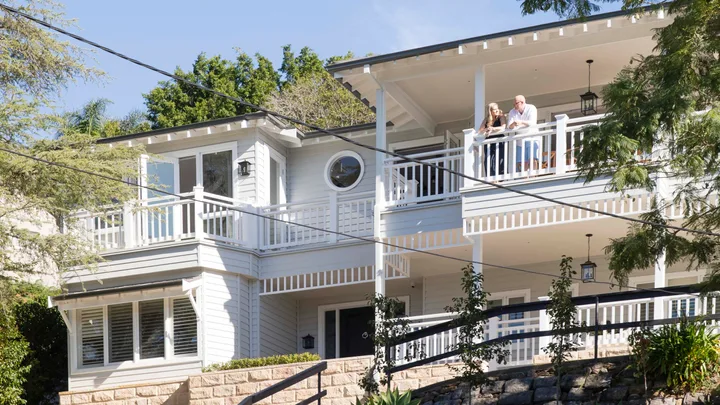
 Photographer: Chris Warnes; Stylist: Fiona Gould
James Treble knows a thing or two about spotting a diamond in the rough when it comes to housing. A former real estate agent, now a qualified interior designer and host of TV’s Renovate or Rebuild, James is in the unique position of being a market expert with a strong aesthetic sensibility. What’s more, he recently bought and renovated his own dream home on the New South Wales Central Coast.
When Home Beautiful editor Elle Lovelock sat down with James on The Edit podcast, she drilled him for his tried-and-tested tips for buying a house to renovate.
James and his partner, artist Sandro Nocentini, recently bought and renovated a 1950s red brick, “ugly duckling” home, completely transforming the façade and aspects of the layout to create their dream home.
“The kitchen became a bedroom, the smallest bedroom became a bathroom, the bathroom became a hallway,” James explains.
But how did James spot the potential in a house that had so little visual appeal?
Listen to James Treble on The Edit podcast:
Read on for James Treble’s key tips, or listen to his episode of The Edit podcast, to discover how he found, bought and renovated his ‘forever home’ — and how you can do it too.
5 tips for buying a house to renovate
…and how to keep costs down!
1. How to find “solid bones”
Seeing a home’s potential is easier said than done. Fortunately, James has a hot tip on how to instantly spot “good bones”.
“When I looked at a home, I look straight at the corners of the windows and the corners of the doorways, internally,” he began. “If there’s any cracks in those corners, that means there’s movement. This means there’s a structural issue, which opens up a negative opportunity for costs.” In other words, cracks in the corners could indicate you have a money pit on your hands. For James, even though he deemed his house “ugly”, he knew he wouldn’t have structural issues thanks to there being no cracks in the corners and crevices.
Also consider any other innate structural features that will be a blessing. In James’ case, his house also had high, 2.7-metre ceilings — a very desirable home feature that is near impossible to create without a full structural renovation.
2. Look for natural light
“Natural light and airflow are the two things I look at in every client’s home,” James explains. “If I don’t have that in a house, it’s hard to replicate.” James notes that he can add “marble and gold and gorgeous finishes”, however, adding or moving windows and doors is a larger renovation. Ideally, your home will already have good natural light and airflow, with a structure that accommodates these things throughout.
3. Choose the right location
Location is obviously important, but what exactly is a “good” location? And are there any tricks to unearthing a good location before everyone else?
For James, a good location means an area that works for you, in terms of access to amenities and proximity to school or work. From here, you need to “look at what else is happening in that street,” James says. “Ideally, I don’t want to build my beautiful new home next to a quarry, or next to a garbage tip or a car park. So, you need to know how that [home] relates to the rest of the suburb.”
You will also need to look at council plans to discern any future zoning or construction obstacles that concern you (i.e. if there are plans to build a highway or airport nearby).
Finally, finding a good location before others comes from expertise or research. Real estate agents or buyer’s agents are able to assist, but you can also save on costs by doing a bit of research yourself. “Generally, I look at house pricing, how it’s going in that area,” James says. “I think that everyone can do that these days. You can go on one of the websites, like realestate.com.au or Just Listed or something, and see how houses [in that area] are selling.”

4. See potential for bathrooms and kitchens
They say bathrooms and kitchens sell homes. However, James has some simple ways to improve these amenities, if your potential home isn’t currently fit-out to your expectations.
For instance, you can still look at homes with just one bathroom — which will be more affordable than those with two — if you’re able to imagine building a new one.
“If you’re looking at homes with fewer bathrooms than required, consider how the space could accommodate more,” James notes. “Consider how a laundry could be renovated into a bathroom, or even a butler’s pantry.”
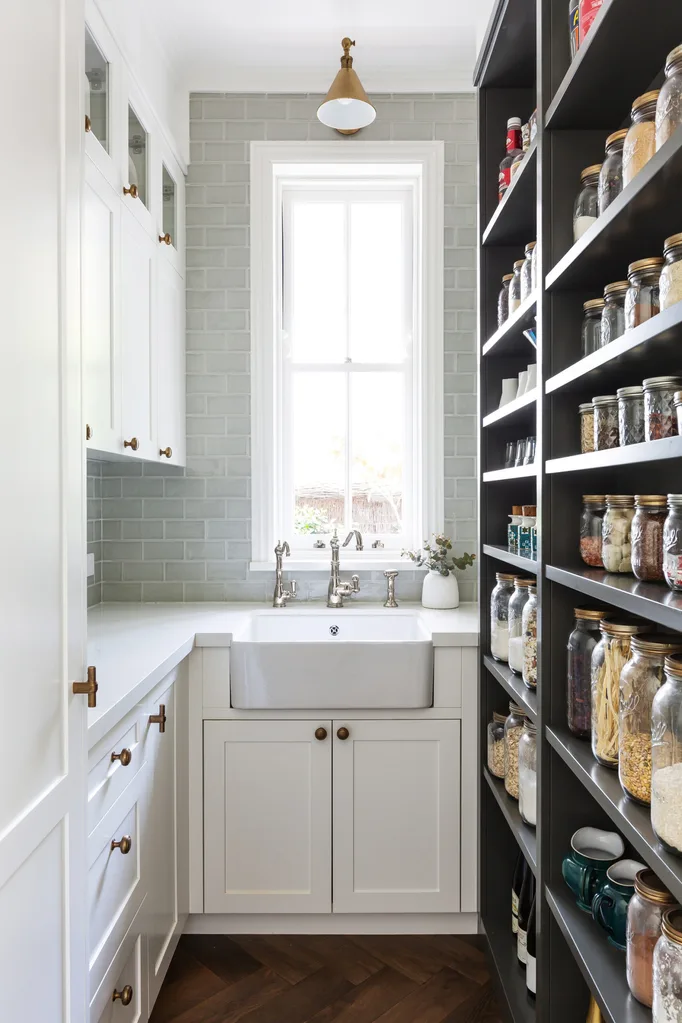
Consider how spaces can be combined efficiently to enhance bathroom and kitchen amenities, such as combining your laundry and butler’s pantry. (Photographer: Simon Whitbread | Styling: Corina Koch)
He also points out that laundries are typically located near kitchens. This offers potential to create a butler’s pantry — which James says adds “huge value” to a home — with your washing machine built into it. You can also, in some cases, move your washer and dryer into a deep linen cupboard, freeing up the space made available by the full laundry room for additional bathroom or kitchen amenities.
5. Trending architectural styles
James also revealed the architectural styles that may provide value in the future.
“I think the ‘70s houses are fantastic,” he began. “I think the ‘70s were such a great design decade. I think ‘60s homes are pretty strong as well.” While James concedes there are some good ’80s builds, he notes this was the decade where builders and developers started mass producing houses that were more cost-effective to build, but not necessarily cheaper to buy.
So, there you have it: A few handy tips to help you spot a hidden gem in the real estate market. For more advice, listen to James Treble on The Edit podcast, or watch the vodcast on YouTube.

