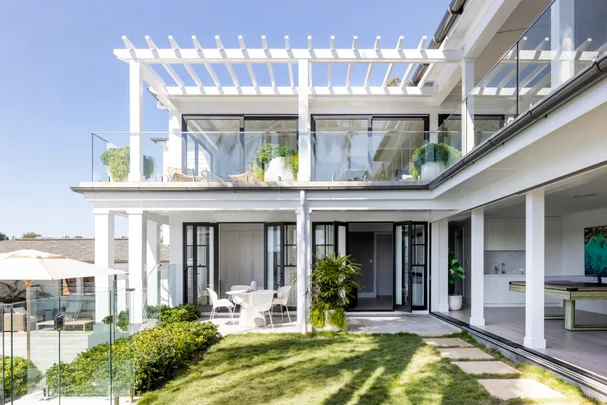
 Photography: Simon Whitbread / Styling: Olga Lewis
To renovate, or knock down and rebuild? It’s an age-old question that can stump even the savviest homeowner. The answer depends upon your goals, budget, the assets and downfalls of your home and, most importantly, its condition.
For television presenter Sophie Falkiner, when it came to the creation of her almost-finished home on Sydney’s Northern Beaches, it was a also a battle of wills with her husband.
“It should’ve been a knockdown… My husband ideally would’ve loved to have knocked it all down, done a [built-in] garage and made it more user-friendly.”
Sophie Falkiner, television presenter
What they settled on was essentially a new build…within the old home’s structure. New windows, new roofline, new walls and floors, and a new floor plan. “Everything has been ripped up,” Sophie told Elle Lovelock on The Edit podcast. “The tiles have come off the pool. All the vegetation has been pulled up. It’s almost like a blank canvas.”
So, if a home that felt new was the goal, why renovate? Below, with the help of Janette Stritt of Stritt Design & Construction, we discuss the pros, cons and considerations for each option.
Choosing to renovate
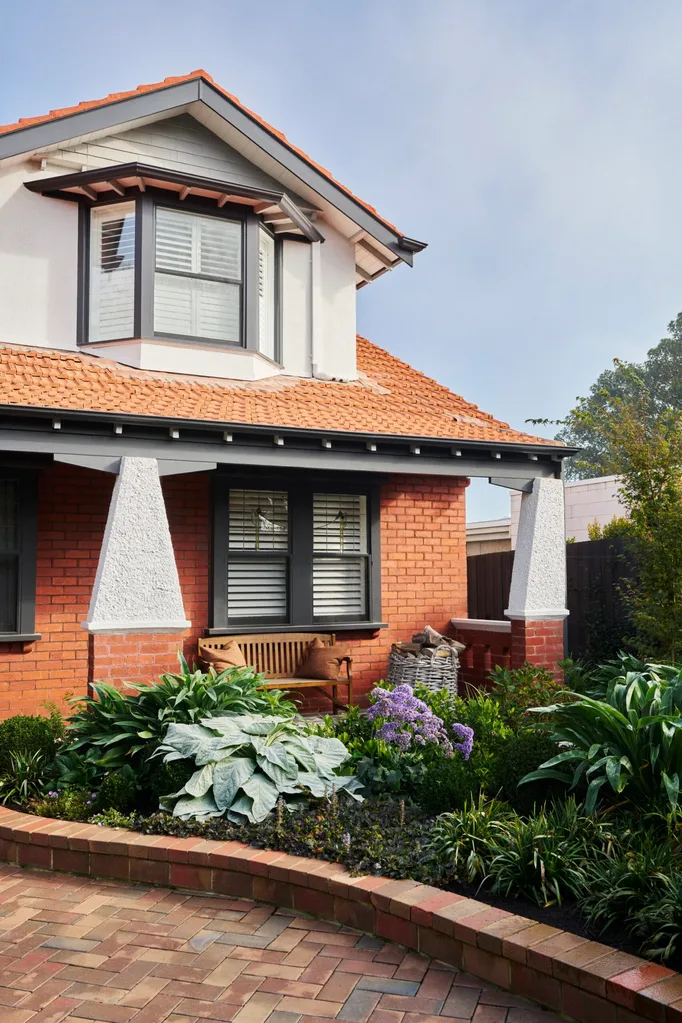
There are plenty of advantages to making the most of what you have, especially if your house has what we in the industry refer to as “good bones”. Even if your home has a poky floorplan, there’s not much that can’t be remedied depending upon the extent of your renovation — and your budget.
“Renovating allows you to preserve character or period details, which can be particularly appealing in heritage conservation areas,” explains Janette. “It may be suitable when the home’s structure is sound, and you’re looking to update or extend.”
It’s relatively easy to rejig a floorplan, and Sophie knew she was in for an overhaul when she realised you could hear people’s most intimate moments from the living spaces.
“Where our powder room used to be, it was facing the ocean. It was the best room in the whole house. The design was so terrible, and literally you’d be [in] the living room, at the kitchen table, and you could hear people doing a wee.”
Sophie Falkiner, television presenter
By renovating, Sophie has been able to harness the powder room’s view and now overlooks the ocean from her kitchen sink. It also meant that she was able to keep the pool in its current position and at its current size, neither of which would be permitted by current standards. She has even included a “re-tox, detox” zone, complete with champagne, an infrared sauna and steam room. The opportunities can really be almost limitless.
That said, renovation costs can be unpredictable, explains Janette. “Hidden issues like any structural damage or outdated wiring can escalate quickly. A new build, however, can typically provide more cost certainty and complete design freedom from the outset.” Other common causes for concern include sloping floors and uneven walls, toxic materials such as lead paint and asbestos, and water or termite damage.
Advantages of a new build

A new home, on the other hand, allows you to start from scratch and create a space that is completely custom-tailored to your lifestyle in a way that extends beyond floor plans and finishes. It offers, as Janette says, complete flexibility.
“New builds benefit from improved energy efficiency, thanks to compliance with BASIX and NCC requirements,” explains Janette. “Using enhanced insulation, double glazing and solar readiness can help reduce long-term utility bills. You can also future-proof your home by considering smart wiring, automation systems, and even EV chargers. And because everything is brand new, your maintenance costs can be significantly reduced.”
While creating a new home is, of course, a costly process, it may surprise you to discover that it is often less expensive than a full renovation of an existing home, which may come with its own raft of issues, especially if structural changes are involved.
Before you start…
Whether you are building or renovating, it’s always wise to leave 10 to 20% of wiggle room in your budget to allow for contingencies or mistakes. If you’re demolishing an existing home, things like asbestos removal can significantly add up. If you are renovating, you may be met with uneven walls, rotting floors, termites, rising damp and hazardous materials (such as lead paint) — and the likelihood only increases if your home is heritage.

Related stories

Native ad body.
Native ad body.




Native ad body.