


 Photography: Tom Blachford
At first glance, you’d never suspect that this supremely sophisticated apartment once lacked character and charm. But that’s exactly the state developers left it in when they converted the 1891 building into apartments. Two bedrooms were squished into the small abode, and all the architectural character of the Queen Anne Revival-style exterior was lost.
Thankfully, when business owner Giang first laid eyes on the space, she was drawn in by its good bones and inner-city Melbourne view overlooking the rooftop of Flinders Street Station. She bought the apartment and hired Anouska Milstein, director of Studio A.mi, to transform it into a pied-à-terre for herself, her husband Esmond and their daughters, Claire, 14, and Sophia, 16.
The style inspiration? “A Parisian hideaway,” says Anouska, who adds that other global design references abound. “It’s a playful collision. Everywhere you look is a blend that feels purposeful and intriguing.” And beneath the decorative detailing is a design that feels bigger than the floor plan gives it credit for.
Key measurements in this apartment
Total size: 56m2
1 bedroom
1 bathroom
The small apartment renovation
A partition wall with sliding doors previously halved the living area, creating a cramped second bedroom and obstructing half the windows overlooking the cityscape. As the additional bedroom wasn’t necessary for a weekender, Anouska removed the wall and restored the uninterrupted views. The communal area now feels expansive and a sofa bed ensures the apartment can sleep the entire family. “We’ll often lie there and watch TV together,” says Giang.
The removal of a lowered bulkhead ceiling in the kitchen rounded out the apartment’s architectural changes. As for the cosmetic transformation, Anouska restored the Queen Anne Revival style, as per the original building, then pared back embellishments with sleek French Art Deco accents.
How to maximise space in an apartment
Anouska proved that you don’t need to make workspaces smaller in order to create more room to relax. Furnishings weren’t the issue here; unnecessary circulation space was.
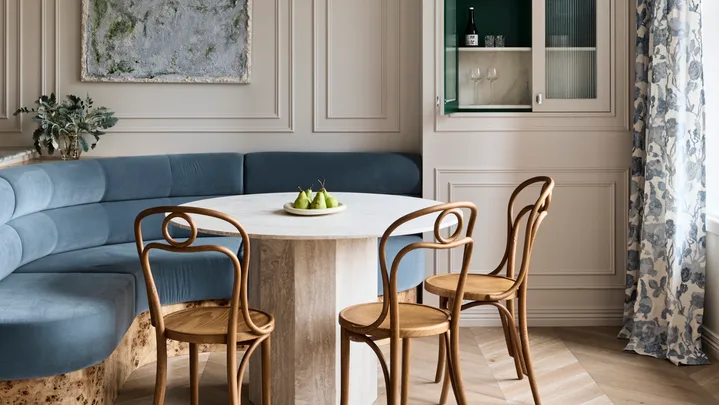
The single-wall kitchen became a galley with the addition of the island, complete with curved banquette seating that runs along the far side of the island and adjacent wall. “The banquette made use of the back of that joinery, which otherwise would’ve interrupted the flow,” says Anouska of the nook. “Rather than being in the way, the kitchen and dining area respond really well as they are now connected.”
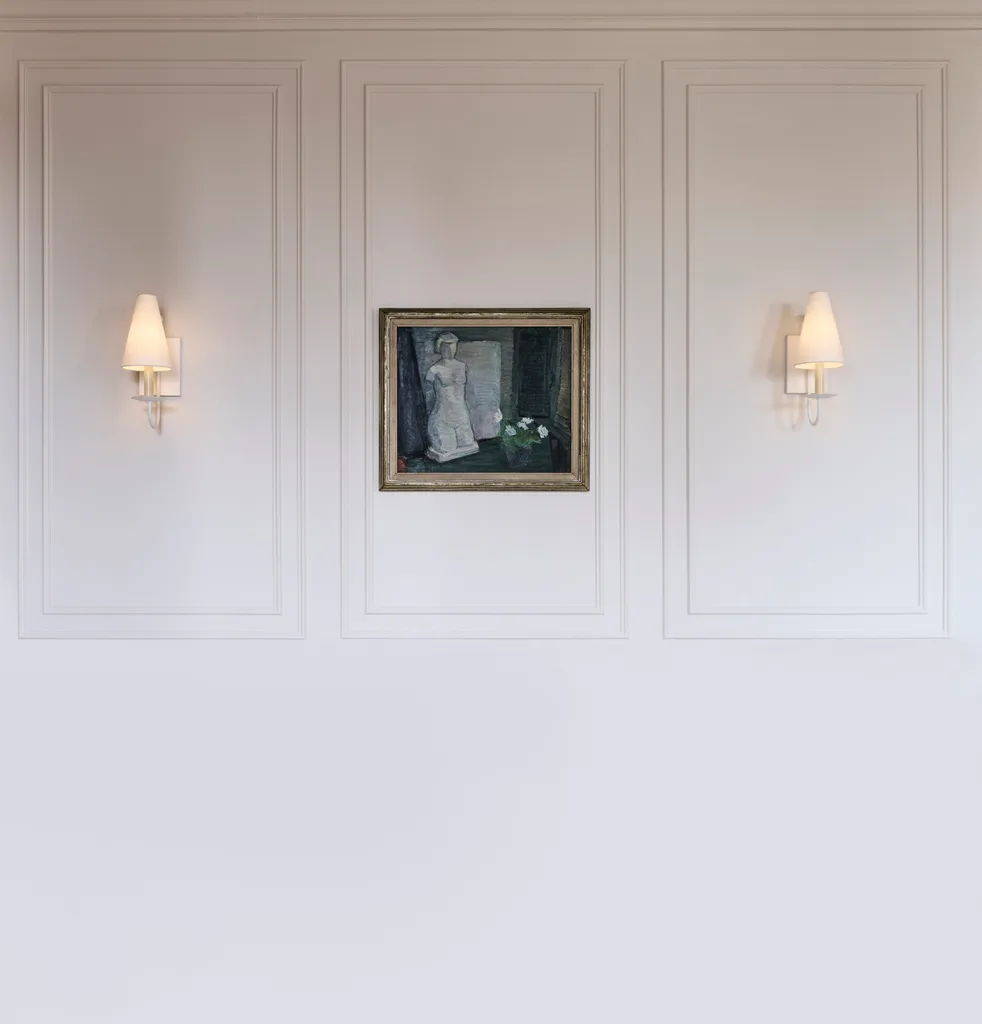
Potentially bulky fixtures, such as the rangehood, recede gently into the background thanks to round edges and soft neutrals in tones similar to the wall finish, aiding the illusion of size.
The kitchen
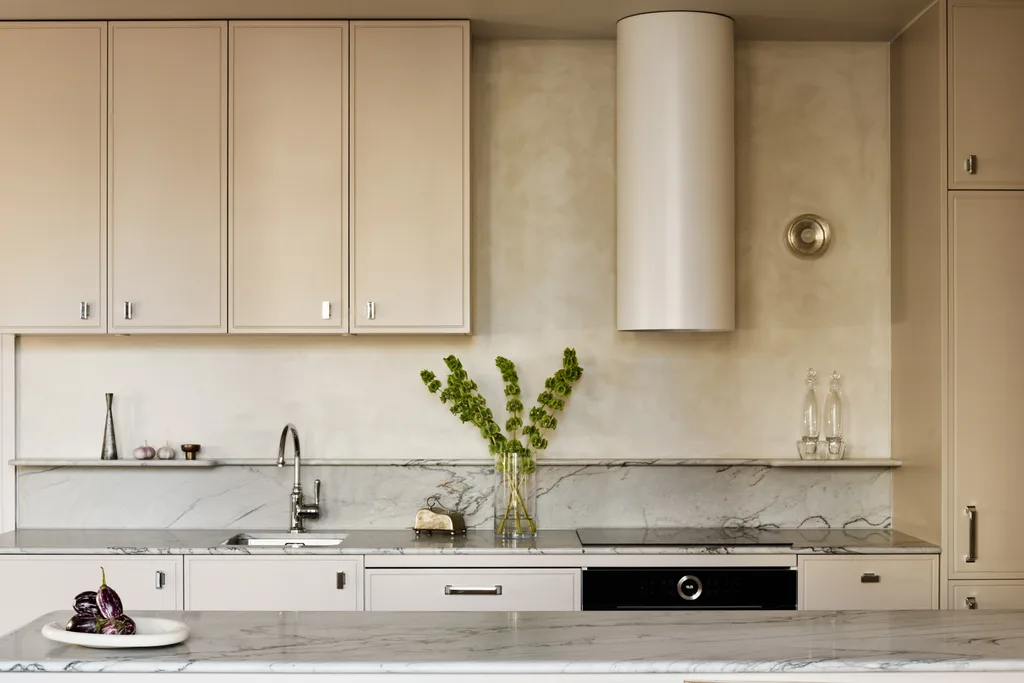
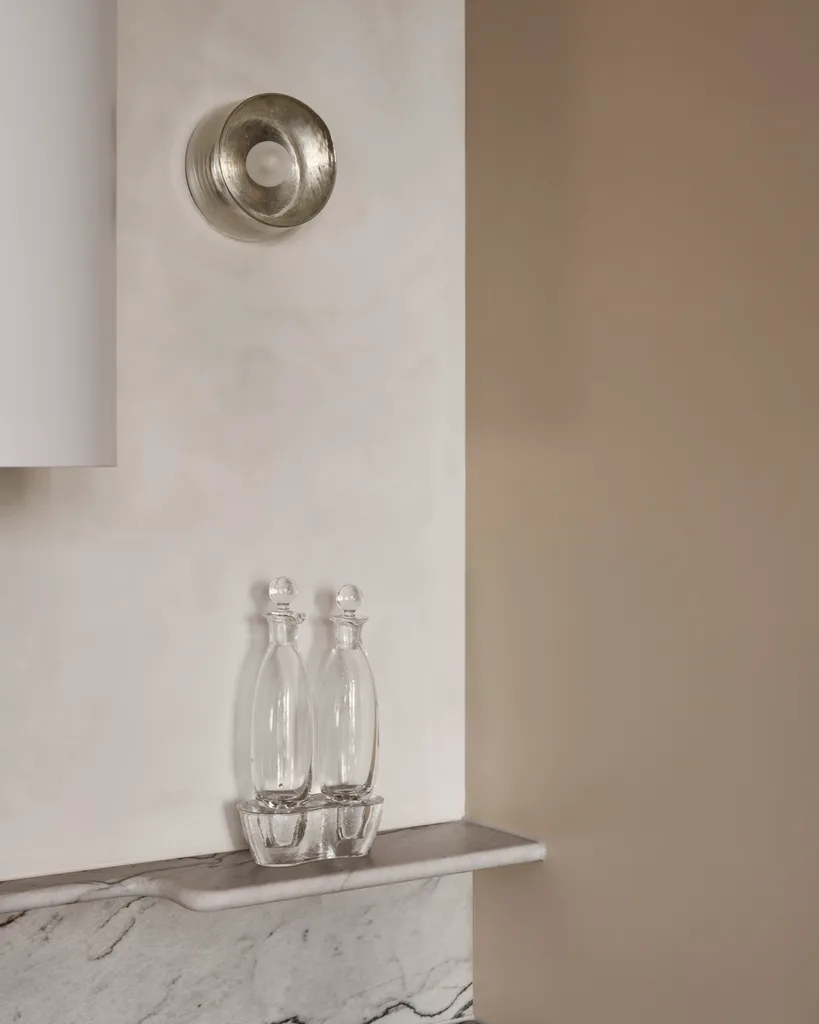
A cylindrical Falmec rangehood canopy in White Polar is unobtrusive against the limewashed walls. Infinity White quartzite from CDK Stone comprises the benchtops and a modest splashback, culminating in a ledge for vintage treasures and other sculptural kitchen utensils. A discreet skinny Shaker profile adorns the kitchen joinery, in Porter’s Paints Irish Elk with Castella ‘Buckhurst’ pulls in Chrome.
Anouska is proud of the lighting scheme, including a Volker Haug ‘Anton’ sconce. “Everything is dimmable,” she explains. “There are many ways you can occupy the space and the lighting is perfect for all.”
Dining area
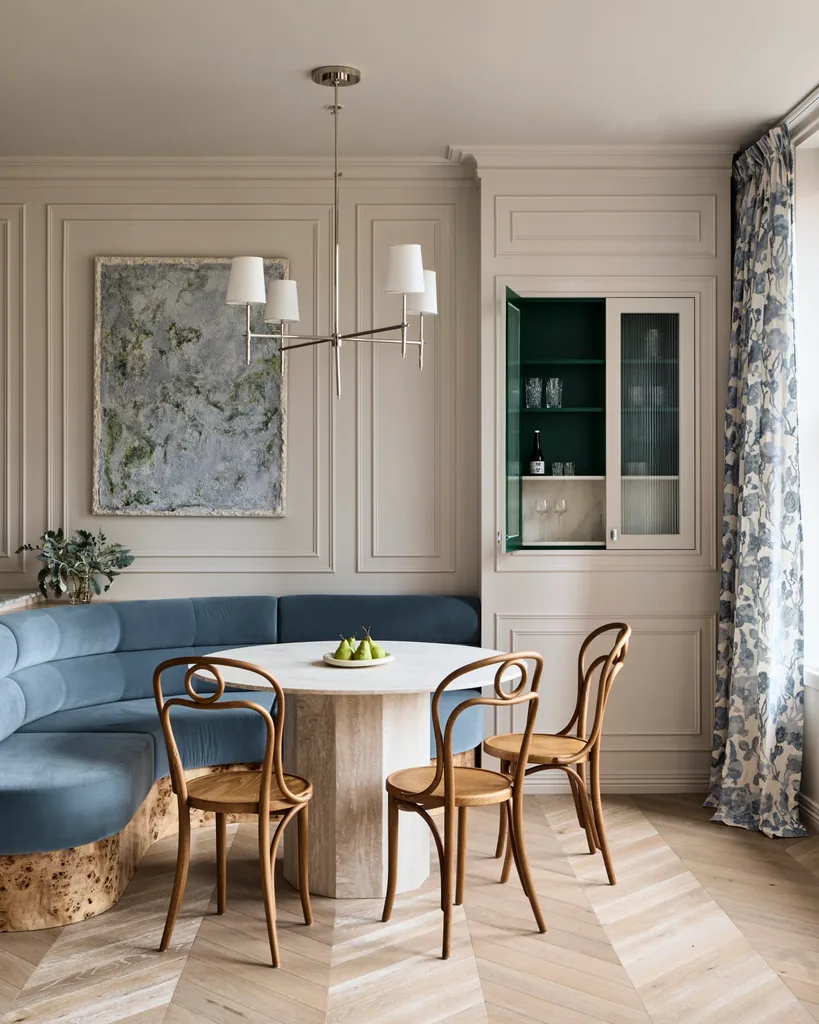
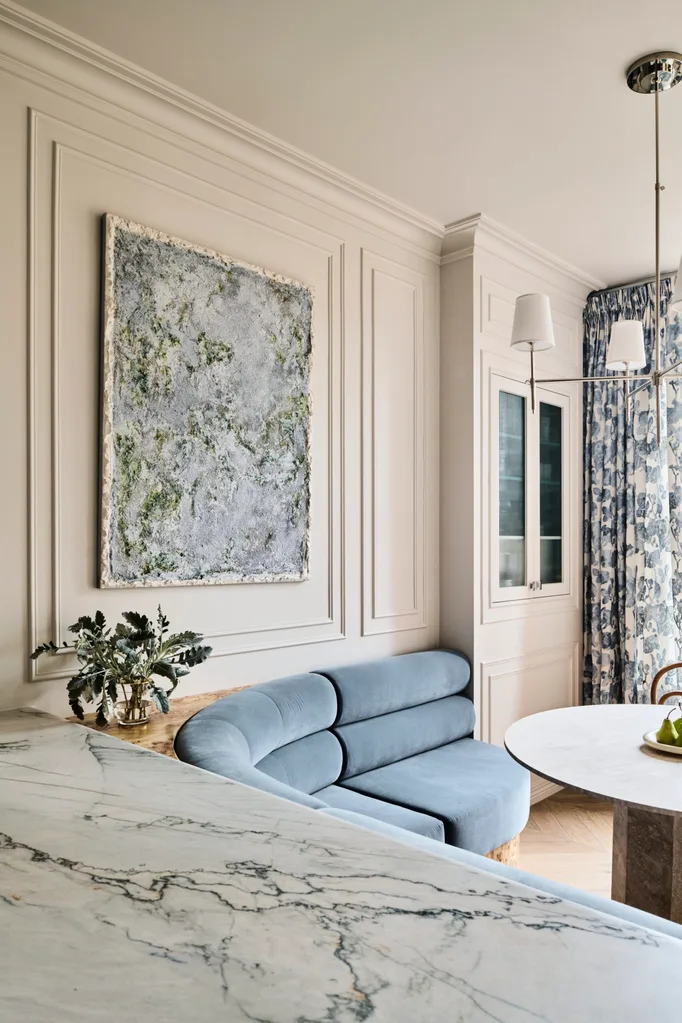
The built-in banquette, upholstered in Zepel Fabrics ‘Lech’ in Sky, is Giang’s favourite feature in her apartment. The seat cushions lift to reveal concealed storage, while the Briggs Veneers base in Poplar Burl complements the Thonet ‘No. 31 Fureau’ dining chairs in Golden Oak. The bar in the built-in joinery adds another indulgence in the small space.
Living area
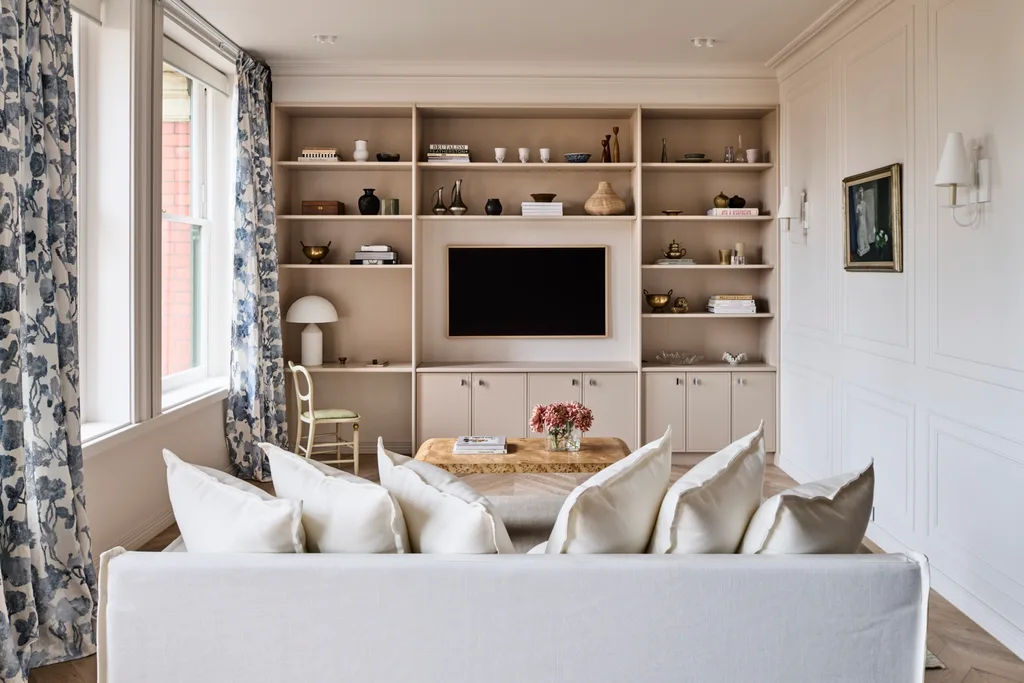
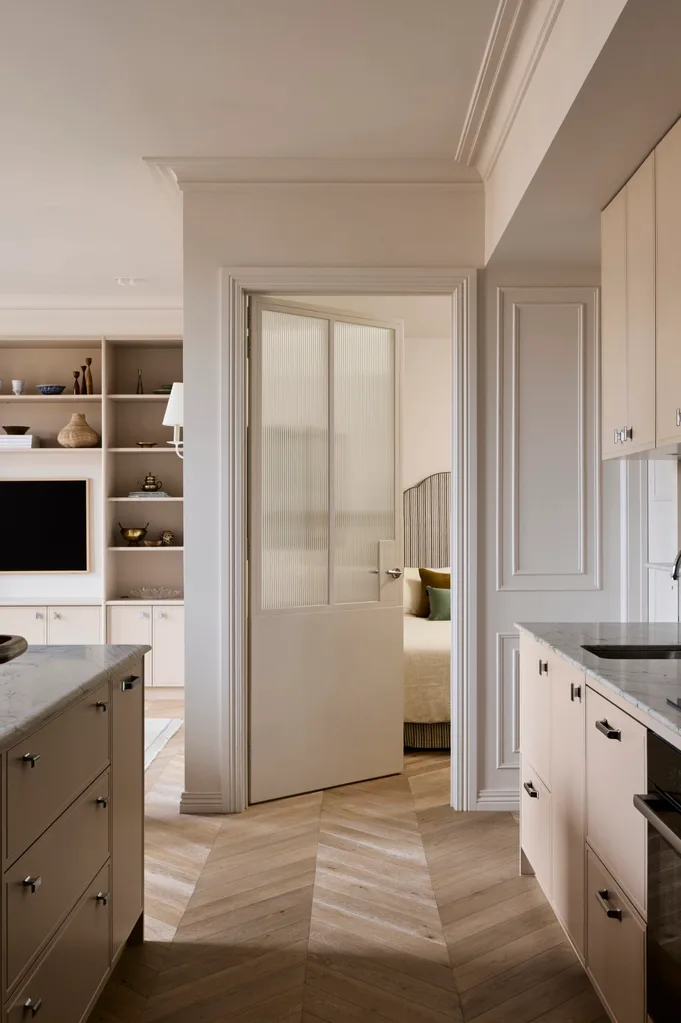
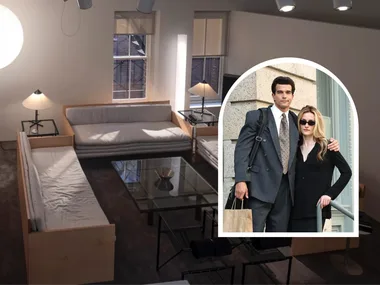
“We worked really hard on the plans to make sure we were maximising the space,” says Anouska. Floor-to-ceiling joinery finished in Porter’s Paints Irish Elk utilises a mix of open shelves and closed cabinetry,
so that everything has its place. A coffee table from James Said is a tactile centrepiece, which also mirrors the burlwood banquette. The Tongue & Groove European oak floorboards in Oslo, laid in a chevron pattern, are carried from the front door to the back wall.
“Originally, I was thinking black, white and greys, so it would be timeless,” says Giang of the colour palette. But Anouska pitched a different idea, featuring a duck egg blue that drew Giang in. The lack of tonal extremes aids a sense of timelessness and the blue is used as a cohesive motif throughout the apartment, as seen in the Mokum ‘Shalimar’ curtains in Copenhagen. Warm neutrals are restful on the eye in these beautiful rooms, including the Brosa ‘Palermo’ sofa bed in White and walls in Porter’s Paints Tofu.
Bedroom
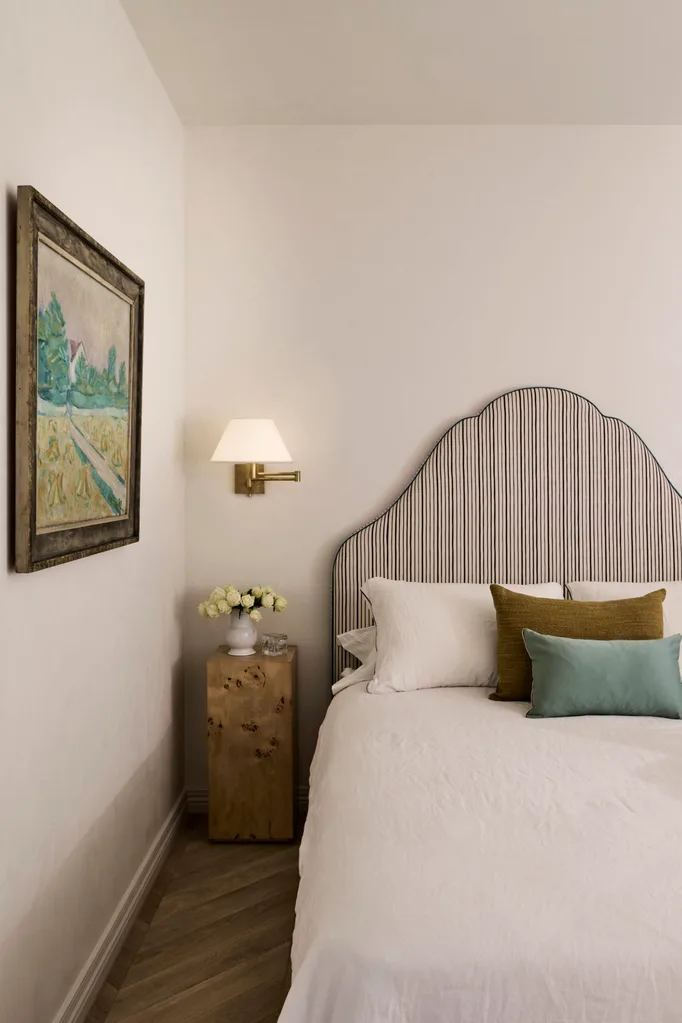
Simplicity sings in the bedroom, from the Heatherly Design ‘Alice’ bedhead in Chocolate Stripe to the landscape by Tage Hedqvist. A ‘Classic Swing Arm’ sconce from Cromwell frees up space on the compact Nuage ‘Louvre’ plinth.
Bathroom
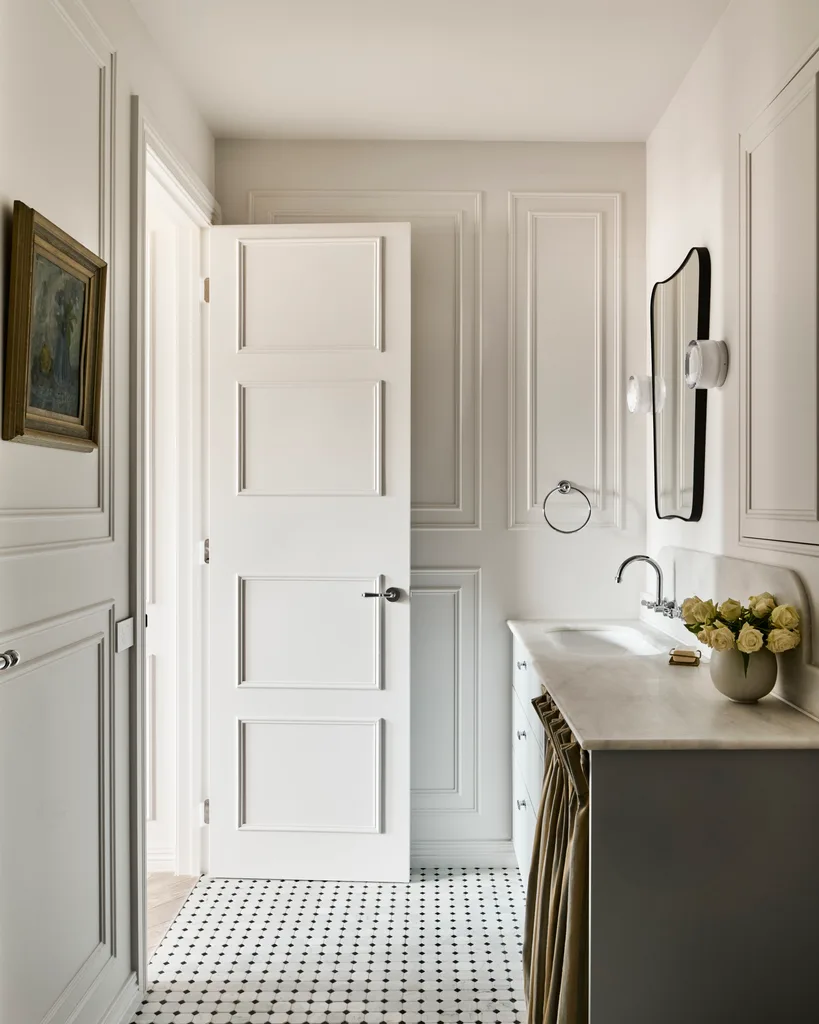
“I liked the idea of the decadence,” says Anouska of the double picture-frame mouldings that feature throughout the apartment. They add opulence to the interiors, which complement the building’s heritage without making the space feel smaller. In the bathroom, the mouldings even cleverly conceal storage. The panel to the right of the Gubi mirror pushes open to reveal a cupboard for toiletries. Anouska then fitted a combined washing machine-dryer underneath the vanity. It was pushed into the deep wall and masked by a sink skirt in Warwick ‘Stratford’ fabric in Duck Egg.
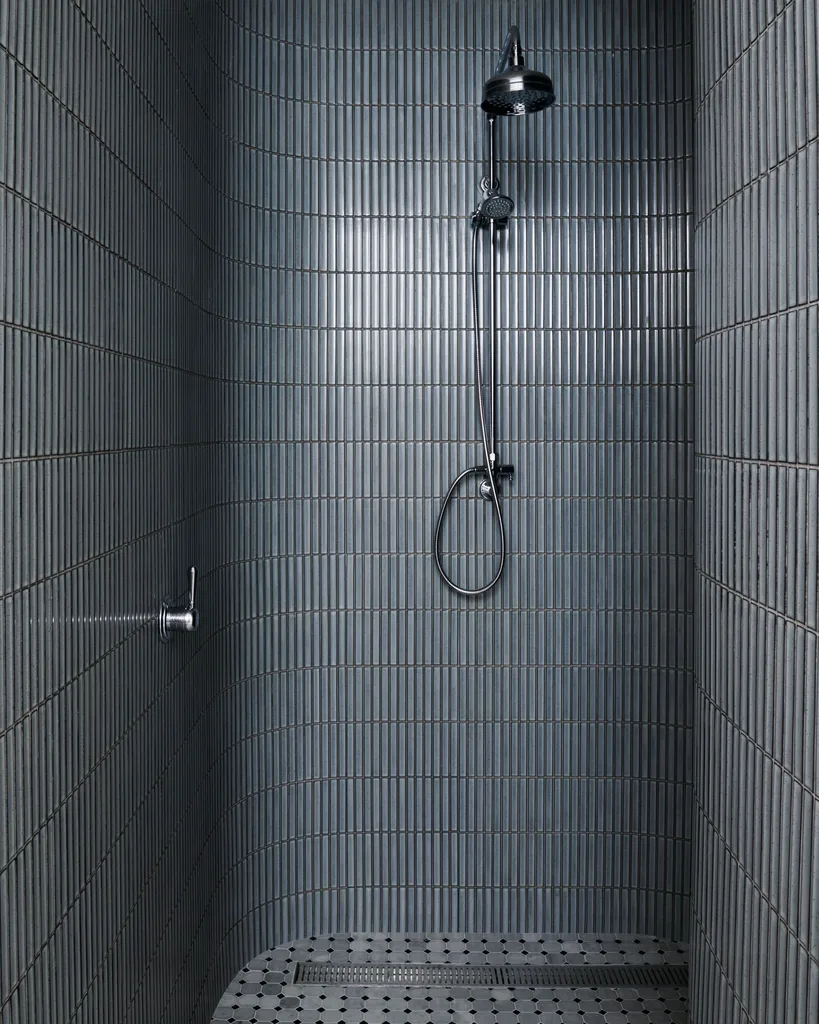
“There was a big brick pillar in the bathroom and we couldn’t demolish it,” says Anouska. In a stroke of genius, she curved the shower walls, then clad them and the pillar in deep blue Signorino kit-kat tiles. “You are almost stepping through a portal,” she says of how the shower now opens up behind the pillar, where a niche is tucked neatly away.
Source book
Interior design: Studio A.mi, studioami.com.au.

Be the first to read this story by subscribing to Home Beautiful magazine

